


Bunions in Waco: When Is It Time to Consider Bunion Surgery?

Having a bunion does not automatically mean you need surgery. If it is not painful, does not limit your shoes, and is not changing what you do, I do not recommend fixing it. We treat the patient—not just the X-ray.
A bunion may be worth treating surgically when pain is limiting your walking, exercise, work, shoe choices, or everyday life—and nonsurgical options are no longer cutting it. The decision is not based on how dramatic the bump looks. It is based on how the bunion affects you and what is actually happening inside your foot.
What Is a Bunion, Really?
A bunion is not just an extra piece of bone growing on the side of your foot. The first metatarsal—the long bone behind your big toe—drifts inward while the big toe begins moving toward the smaller toes.
Genetics plays a large role in bunions. If one of your parents has a large bunion, there is a good chance one may be in your future too. Thanks, Mom and Dad! Bunions usually develop from a combination of inherited foot structure and the way the foot moves over time.
Shoes do not create most bunions on their own, but high heels and narrow toe boxes can crowd the toes and put more pressure on the bump, making an existing bunion more painful.
Is Surgery the Only Option?
Absolutely not. Nonsurgical treatment will not correct the deformity, but it can help keep you comfortable and active. Custom orthotics can provide better support and help reduce pain.
Shoes with a wider toe box can reduce pressure over the bump, while toe spacers or gel pads may make certain shoes more comfortable. These options will not make the bunion disappear, but they may help manage your symptoms and delay the need for surgery.
If you have tried these options and your bunion is still calling the shots, it may be time to talk about surgery.
What Kind of Bunion Surgery Do I Need?
There is not one operation that works for every bunion. The right procedure depends on where your pain is coming from, how your foot moves, whether arthritis is present, and the overall structure of your foot.
I check how the big-toe joint moves, whether there is instability at the base of the first metatarsal, and whether arthritis may be part of the problem.
If the instability is coming from the joint at the base of the first metatarsal, I may recommend a Lapidus procedure. This corrects the position of the metatarsal and stabilizes the joint through a fusion, treating the deformity where it begins.

You may also hear me use the name Lapiplasty®. Lapiplasty is the system I use to perform this three-dimensional Lapidus correction. Its specialized instruments help me reposition the metatarsal precisely, and the fixation holds the correction in place while the fusion heals.
Weight-bearing X-rays also show me whether part of the deformity is coming from the big toe itself. If the toe is still angled after I correct the first metatarsal, I may add an Akin osteotomy. This is a small wedge-shaped correction made in the big-toe bone to straighten the toe and improve its alignment.

What If Arthritis Is Part of the Problem?
If a bunion is present along with arthritis in the big-toe joint, correcting the position of the bones alone may not be enough to relieve your pain. In that situation, I may correct the bunion with a Lapidus procedure and use a joint implant to address the damaged cartilage while preserving motion.
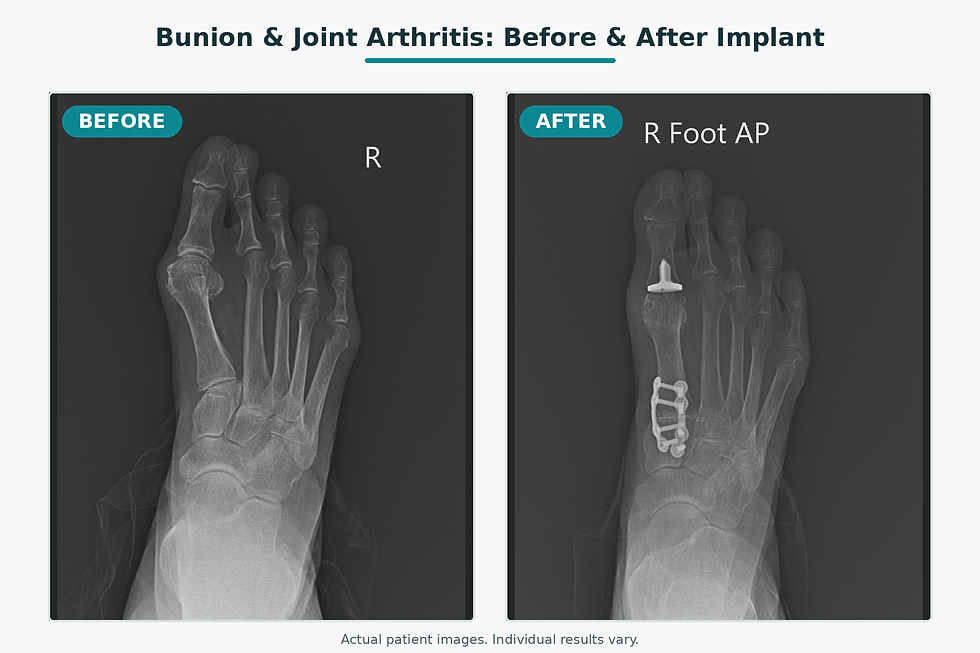
If the arthritis is severe and the painful big-toe joint is the primary problem, fusion may be the better option. Fusion removes the damaged joint surfaces and allows the bones to heal together, eliminating painful motion at that joint.

What Is Recovery Like After Bunion Surgery?
Recovery varies depending on the procedure, your health, and how your X-rays look as you heal. For the Lapidus and Lapiplasty-type corrections I commonly perform, my typical recovery plan looks like this:
The first 1–2 days: Your main job is to rest, keep the foot elevated, ice behind the knee, and stay ahead of the pain and swelling.
The first 2 weeks: You will remain in a protective splint and follow RICE: rest, ice, compression, and elevation.
At 2 weeks: I will remove your sutures and transition you into a boot. You will remain non-weight-bearing and use crutches or a knee scooter to get around.
At 6 weeks: We will take new X-rays in the office to check the healing. If everything looks good, you will begin physical therapy and gradually transition to partial weight-bearing and then weight-bearing as tolerated in the boot.
After week 6: As the bone continues to heal, physical therapy will help rebuild your strength, balance, and mobility. Once your X-rays show enough healing, you will transition out of the boot and into a supportive shoe, then gradually return to normal activities.
Can a Bunion Come Back After Surgery?
Yes, a bunion can return after surgery, but choosing the right procedure for your specific deformity can significantly reduce that risk.
Reducing that risk starts with understanding where the deformity is coming from and correcting it at the appropriate level. That is why I evaluate the entire structure of your foot instead of focusing only on removing the bump. Following all postoperative weight-bearing instructions is equally important because the correction needs time to heal before it is ready to support your full weight.
No bunion surgery comes with a zero-percent chance of recurrence, but choosing the right correction—and protecting it while it heals—gives you the best chance of a lasting result.
Is Bunion Surgery Right for Me?
If your bunion pain is limiting your life and nonsurgical treatments are no longer cutting it, surgery may be the right next step. I’ll look closely at your foot and weight-bearing X-rays, then explain exactly what needs to be corrected and why.
Still Have Questions?
If your bunion is making shoes, walking, or everyday life more difficult, come see me at Brazos Foot & Ankle. We’ll take weight-bearing X-rays, talk through your options, and figure out the best next step for your foot.
Call 254-300-7703 or visit www.brazosfoot.com to schedule an appointment.
Medical note: This article provides general education and does not replace an individual examination, imaging, or medical advice.



Comments